
Dry Ice
Consult your dry ice or CO2 gas supplier for more details, and professional advice for your specific situation.
Overview & Resources
Shipping Refrigerated or Frozen Products
Overview sheet with profile guidelines and tips.
Download PDFDefinition of Dry Ice
Dry ice is a solid form carbon dioxide (CO2) gas and has a freezing temperature at -109.3° F (-78.5°C). It has an unusual property of subliming, that is transitioning from a solid to a gas, without passing through a liquid phase. Dry ice can only exist at -109.3°F or (-78.5°C) and maintains this temperature by sublimation.
How is Dry Ice Made?
Liquid carbon dioxide is the source of dry ice products. Liquid dry ice is stored at 20 bar and approximately -20°C. The liquid CO2 is released through a nozzle to 1 bar at which dry ice snow is created. The dry ice snow is compressed and extruded at approximately 1600 psi to form block or pellet form dry ice.
How do I store Dry Ice?
Store dry ice in an insulated container. Depending on the volume stored, the best container for small volume is the expanded polystyrene foam containers, and larger volumes in a rotation molded insulated filled transport container, with an insulated lid or thick quilted top pads. The thicker the insulation, the slower the rate of sublimation of dry ice (CO2) gas.
DO NOT hold or store in an airtight container or sealed poly bags or glass containers. Sublimation of dry ice (CO2) gas will cause an airtight container to expand, rupture or burst. Always store dry ice in a well ventilated area. CO2 gas is heavier than air, and will drop to low areas and displace air.
Use Cases
🚚 Ship/Transport
- Cold/Frozen Foods
- Temperature Sensitive Medical Supplies, Samples, Equipment
❄️ Flash Freeze
- Food Processing
- Processing Fresh Meat
- Processing Of Ground Meats And Sausages
🌿 Preserve
- Seeds And Grains
- Fresh Fruits
- Fresh Meats
- Green Burials
⚙️ Other Applications
- Severe weather/Power Outages
- Hunting
- Deep Sea Fishing
- Camping
- Kill Fungi And Bacteria
Safety Information
🛡️ Is Dry Ice Safe?
- Always handle dry ice with insulated gloves as dry ice is -109.3°F (-78.5°C) and may cause cold burns if prolonged skin contact.
- Dry ice is non-corrosive, non-toxic and non-conductive.
- Do not ingest dry ice.
- Do not allow unsupervised children near dry ice.
- Do not store or pack in completely airtight containers. The sublimation will cause any airtight container to expand and possibly rupture or explode.
- Intentional misuse of dry ice may be harmful or fatal. Always use extreme caution when handling dry ice.
⚠️ Dry Ice Warnings
- Dry Ice is extremely cold (-109.3° F, -78.5° C) and can cause severe cold burns and frostbite.
- Do not touch Dry Ice with bare hands, use heavy insulated gloves.
- Use protective eyewear when making or handling Dry Ice.
- Dry Ice is not edible. Do not put Dry Ice in your mouth.
- Keep Dry Ice out of the reach of children and animals.
- Do not put Dry Ice in any tightly closed container.
- Do not add Dry Ice to any liquid or any liquid to Dry Ice.
- Make and use Dry Ice only in a well-ventilated area.
- Consult your CO2 tank supplier about recommended procedures.
📋 OSHA Safe Levels of Carbon Dioxide
During Vehicle Transportation:
- OSHA's maximum safe level is 3% (30,000 ppm); lethal concentration (death in 30 minutes) is 10% (100,000 ppm)
- The best way to determine the off gas is to weigh the container; for each pound of Carbon dioxide contains 8.58 cu.ft per lb.
- 3% is a very unsafe level; at 1.5% action should be taken
- Suggestion is to simply put a portable CO2 monitor in the van
- 50 lb. Block contains 50 x 8.58 = 429 cu.ft of gas; the off-gassing would probably take a 7 day period
- Normal is 400 ppm in the atmosphere all the time
Temperature Profiles
Deep Low Frozen (Dry Ice @ −108°F)
For products requiring a DEEP LOW FROZEN profile, general guidelines include using dry ice, approximately 5 to 10 pounds for each 24 hours of transit time. Varying quality and/or larger insulated shipping containers will require more dry ice to cover larger surface area.
Load dry ice on bottom of container, then load products to ship and cover with dry ice. Dry ice will freeze and keep product frozen. For the required amount of days to ship, multiply the dry ice per each 24 hours of transit. Fill all void areas remaining inside insulated container with solid dunnage packaging material. This improves temperature stability and reduces dry ice sublimation.
Mild Frozen (Cold Packs @ 10–30°F)
For products requiring a MILD FROZEN profile, general guidelines for maximum product protection include: Surround product on 2 or 4 sides and on top and bottom. General ratio to start is 1 lb. cold pack per 3 lb. of product and may require more. Fill all void areas remaining inside insulated container with solid dunnage packing material, this improves temperature stability.
Low-Mild Frozen (Cold Packs + Dry Ice)
For products requiring a LOW-MILD FROZEN profile, general guidelines for extended transit from 10 to 24 additional hours include: Surround packed product with frozen cold packs on 2 or 4 sides and place on top and bottom. Place from 1-1/2 lbs. to 5 lbs. of dry ice on top of cold packs and packaging filler to buffer from packed product. This will enhance temperature and transit an additional 10 to 24 hours.
⚠ Warning: Certain temperature sensitive items may be exposed to heat loss and freezing may result. Vaccines not recommended.
Important: Contact parcel shipper for the correct labeling instructions and documents to declare weight and dry ice used in each package.
Always be sure work areas and transport vehicles are well ventilated when working with or transporting dry ice and packages with dry ice. Consult your local dry ice and liquid CO2 supplier for more information.
Packaging Instructions
📦 Packaging Using Dry Ice Only
Deep Frozen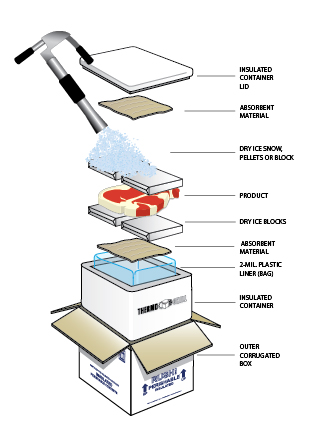
- Line the insulated container with at least one 2-mil plastic bag and sufficient absorbent material above and below the product.
- Double bag products that can thaw or melt.
- Arrange products compactly. Leave space around product for dry ice. Close bag securely.
- Place sufficient amount of dry ice around product. Use dry ice block, pellets or snow.
- Pack tightly and fill void spaces with dunnage packaging material to prevent product movement.
- Place lid on insulated container. DO NOT seal completely – venting is needed to allow CO2 gas to escape.
- Place insulated container inside corrugated box.
- Securely tape corrugated box with plastic carton sealing tape. Complete the required paperwork and labeling.
🧊 Packaging Using Cold Packs + Dry Ice
Extended Transit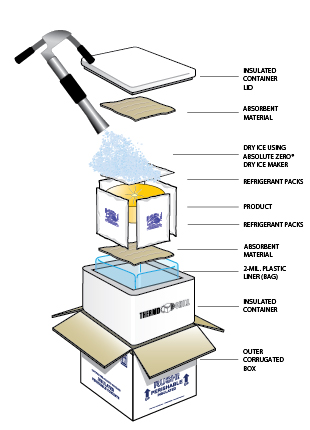
- Line the insulated container with at least one 2-mil plastic bag and sufficient absorbent material above and below the product.
- Arrange products compactly, allowing space for cold packs.
- Place sufficient number of cold packs on top and around product. Pack tightly and fill void spaces with dunnage packaging material.
- Fold or close the liner.
- Apply 1 to 1-1/2 pounds of dry ice snow above secured liner.
- Place lid on insulated container. DO NOT seal completely – venting is needed to allow CO2 gas to escape.
- Place container inside corrugated box.
- Securely tape corrugated box with plastic carton sealing tape.
🔗 Regulating Authorities & Resources
Important Safety Notice
Dry ice is extremely cold at -109.3°F (-78.5°C). Always handle with insulated gloves and store in well-ventilated areas.